the time has come to announce the start of our fifth HUPE in Storyland writing competition. The competition starts on 1 December 2024 and finishes on 15 January 2025. The winners will be announced on 8 March 2025.
How to apply?
Go to the HUPE web page and download the template form. Once downloaded, fill in the required details. After completing the form, generate a password. This password must be used as the title in uploading the document and it has to be incorporated in the document itself.
All the stories must be completely anonymous. No school, mentors’ or students’ names should be revealed before the date of the announcement, 8 March 2025.
After announcing the winners, you will be asked to resend your students’ short stories to prove your identity. Check the HUPE web page for the published ranking list, complete with passes, to ensure your students' rankings are accurate.
There are three categories in the competition, make sure you select the category you are applying for.
the time has come to announce the start of our fifth HUPE in Storyland writing competition. The competition starts on 1 December 2024 and finishes on 15 January 2025. The winners will be announced on 8 March 2025.
How to apply?
Go to the HUPE web page and download the template form. Once downloaded, fill in the required details. After completing the form, generate a password. This password must be used as the title in uploading the document and it has to be incorporated in the document itself.
All the stories must be completely anonymous. No school, mentors’ or students’ names should be revealed before the date of the announcement, 8 March 2025.
After announcing the winners, you will be asked to resend your students’ short stories to prove your identity. Check the HUPE web page for the published ranking list, complete with passes, to ensure your students' rankings are accurate.
There are three categories in the competition, make sure you select the category you are applying for.
PRIMARY SCHOOL - 5TH AND 6TH GRADE
Students are invited to write a story up to 1000 words. The topic and the title of the story are of students’ own choice, but the rubric below is obligatory for all contestants and will be used when assessing short stories.
Criteria
1
2
3
4
Vocabulary
The vocabulary is not varied or is routinely inappropriate for the story.
Uses a good range of vocabulary that is often too simple.
Uses a good range vocabulary that is occasionally a little too simple.
Uses a varied vocabulary appropriate for the story.
Organization & Structure
Ideas and scenes seem to be randomly arranged.
The story is a little hard to follow. The transitions are sometimes not clear.
The story is pretty well organized. One idea or scene may seem out of place. Clear transitions are used.
The story is very well organized. One idea or scene follows another in a logical sequence with clear transitions.
Language Use
(Sentence structure, word choice, grammar, spelling, punctuation)
Many errors in grammar, spelling, and punctuation, which makes comprehension difficult.
Frequent errors in grammar, spelling, and punctuation, which creates some difficulty in comprehension.
Correct grammar, spelling, and punctuation with few errors.
Correct grammar, spelling, and punctuation with very few errors.
Creativity
There is little evidence of creativity in the story. The author does not seem to have used much imagination.
The story contains a few creative details and/or descriptions, but they distract from the story. The author has tried to use his imagination.
The story contains a few creative details and/or descriptions that contribute to the reader's enjoyment. The author has used his imagination.
The story contains many creative details and/or descriptions that contribute to the reader's enjoyment. The author has really used his imagination.
PRIMARY SCHOOL - 7TH AND 8TH GRADE
Word limit for 7th and 8th grade is from 1000 – 2000 words. Students choose the topic and the title according to their preferences, but the rubric below is obligatory for all contestants and will be used when assessing short stories.
Criteria
1
2
3
4
Vocabulary
The vocabulary is not varied or is routinely inappropriate for the story.
Uses a good range of vocabulary that is often too simple.
Uses a good range vocabulary that is occasionally a little too simple.
Uses a varied vocabulary appropriate for the story.
Organization & Structure
Ideas and scenes seem to be randomly arranged.
The story is a little hard to follow. The transitions are sometimes not clear.
The story is pretty well organized. One idea or scene may seem out of place. Clear transitions are used.
The story is very well organized. One idea or scene follows another in a logical sequence with clear transitions.
Language Use
(Sentence structure, word choice, grammar, spelling, punctuation)
Many errors in grammar, spelling, and punctuation, wh ni ich makes comprehension difficult.
Frequent errors in grammar, spelling, and punctuation, which creates some difficulty in comprehension.
Correct grammar, spelling, and punctuation with few errors.
Correct grammar, spelling, and punctuation with very few errors.
Creativity
There is little evidence of creativity in the story. The author does not seem to have used much imagination.
The story contains a few creative details and/or descriptions, but they distract from the story. The author has tried to use his imagination.
The story contains a few creative details and/or descriptions that contribute to the reader's enjoyment. The author has used his imagination.
The story contains many creative details and/or descriptions that contribute to the reader's enjoyment. The author has really used his imagination.
SECONDARY SCHOOL
Students from all four grades of secondary school may take part in the competition. The task is to write a short story that is 2000 – 3000 words long. They are free to choose the topic and title of the story according to their personal preferences, but the rubric below is obligatory for all contestants and will be used when assessing short stories.
Criteria
1
2
3
4
Plot, Setting, Details, & Development
Little to no plot line
Uses little to no details
Provides minimally developed plot line
Attempts to use details and/or suspense, dialogue, and action, but with minimal effectiveness
Develops a standard plot line
Less-developed setting
Uses a range of literary devices (such as suspense, dialogue, and action).
Advances the plot, and keeps the reader informed or entertained
Skillfully develops plot line
Clear setting
Uses a wide range of literary devices (such as suspense, dialogue, and by action).
Skilfully advances the plot, and keeps the reader continually informed or entertained
Characters
Characters are underdeveloped and don’t have an adequate background, personality, or motivation. They don’t feel like real people at all.
Some attempt was made to create a background, personality, and motivations, but the characters don’t feel real. The characterization is weak.
Characters fall just short of feeling real and three-dimensional. They are missing something essential: a fully developed background, identifiable motivations, or consistent personality.
Characters feel like real people. There’s a sense of history and background. They have clear personalities and the reader understands their motivations.
Organization & Structure
(Paragraphs, Transitions)
Little to No Structure:
Little to no sequencing of ideas
Isolated events
Weak Structure:
Sequencing of ideas in text body and/or resolution need revision
Some isolated events with weak sequencing
Effective Structure:
Engaging hook
Logical sequencing of ideas based on purpose
Resolution
Skillful Structure:
Strong, engaging hook
Logical and effective sequencing of ideas (structure) based on purpose
Clear resolution
Originality
(Expression of the topic in a creative way)
No experimentation nor enhancement of concepts. No adherence to the topic.
Very little experimentation to enhance concepts. Does not exhibit creativity.
Sufficient experimentation with language and usage to enhance concepts. Applies basic creative skills to relay ideas.
Distinctive experimentation with language and usage to enhance concepts. Applies higher order thinking and creative skills to relay complex ideas.
Language Use & Conventions
(Sentence structure, word choice, grammar, spelling, punctuation)
Little or no use of elements of conventions. Many errors in grammar, spelling, and punctuation, which makes comprehension difficult.
Some use of elements of conventions. Contains frequent errors in grammar, spelling, and punctuation, which creates some difficulty in comprehension.
Appropriate use of elements of conventions. Uses correct grammar, spelling, and punctuation with few errors.
Effective and creative use of elements of conventions to enhance meaning Uses correct grammar, spelling, punctuation throughout with very few errors.
Prizes:
→ FOR MENTORS: free conference fee for the mentors of best stories
→ FOR STUDENTS: a gadget for the students of best stories in all categories
The prizes for our winning storytellers are generously sponsored by our partner ALFA.
IMPORTANT! The certificates for the winners and their mentors will be sent via mail once they confirm their identity by resending a story. All participants can also get their certificates of participation once they resend the stories. Don’t forget, ONLY HUPE members can take part in the competition.
Finally, it is important to inform all the participants that all the stories will be checked by the ChatGPT Checker.
Thank you for taking part in the HUPE competition, let’s get the creative juices flowing!
Good luck!
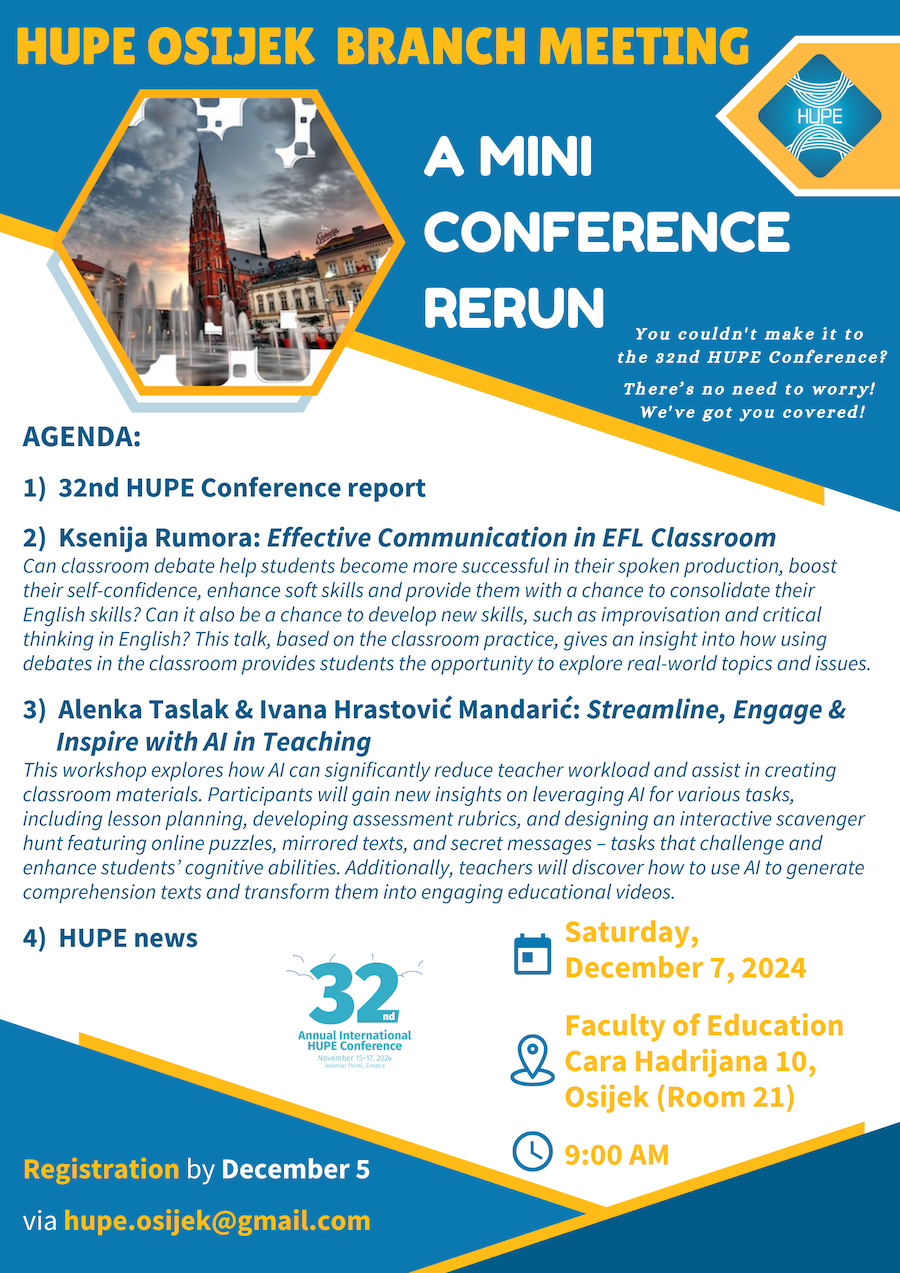
1st HUPE Osijek branch meeting invitation
Dear colleagues,
I would like to invite you to our first HUPE Osijek Branch meeting in the school year 2024-2025, which will take place on Saturday, December 7, 2024 at 9 am at the Faculty of Education in Osijek (Fakultet za odgojne i obrazovne znanosti, Ulica cara Hadrijana 10, Osijek) in Room 21.
Agenda:
32nd HUPE Conference report
Ksenija Rumora: Effective Communication in EFL Classroom
Alenka Taslak & Ivana Hrastović Mandarić: Streamline, Engage & Inspire with AI in Teaching
HUPE news
For those of you who won't be able to join us at the 32nd HUPE Conference in Poreč and those who won't have time to attend all the desired workshops at the conference, we have prepared a mini conference rerun with interesting and practical workshops (summaries available below) prepared by our branch members. .
If you would like to attend the meeting, please, register by sending an email to This email address is being protected from spambots. You need JavaScript enabled to view it.by Thursday, December 5, 2024at 8 pm the latest, so it's easier for me to prepare everything on time. Thank you.
I’m looking forward to seeing you.
Kind regards,
Adrijana Roždijevac HUPE Osijek Branch President
FINAL PROGRAMME FOR THE CONFERENCE
Here you can have a look at the final programme for our 32nd HUPE conference. Any unavoidable last-minute changes will be published on our HUPE notice boards in front of the Diamant Hall at the Conference or using a QR code that will be provided in our Conference brochure.
We hope to see as many of you as possible at the conference and we especially thank all the speakers for their application.